
Thursday, March 5, 2009

Thursday, February 26, 2009
No Tweeting in Meetings!
 A friend of mine was watching Barack Obama's speech on Tuesday, and noticed that all of the legislators sitting in the audience had their Blackberries out, twittering away while the TV cameras rolled. She suggested that it was disrespectful (regardless of politics) to be sitting there listening to a speech while apparently preoccupied with other things.
Granted, they may have been twittering about the speech itself, but what could POSSIBLY be so important that they couldn't twitter about it an hour later when they're not sitting in front of the guy who's speaking? Multi-tasking is good, but whatever happened to polite, active listening? Whatever happened to etiquette?
She suggested I write about business etiquette and ethics topics that are new. She would like some information to hand out to new employees that covers things the Emily Post wouldn't have thought of.
Here are some of our initial ideas:
- Tweeting (texting, IMing, etc.) in meetings!
- Texting or cell phoning while driving!
- Things not to discuss in Facebook
- Getting people's permission before posting photos that could be embarrassing in Facebook or MySpace (or videos on YouTube!)
- Topics that should be discussed in person (you shouldn't break up with someone or fire them by text!)
- When you should send a handwritten note rather than a text or tweet.
-Paula
Monday, February 23, 2009
Etiquette Question - Escorting Guests to a Conference Room
Dear Paula,
I am the Executive Assistant to the President of a small manufacturing company and when the president has a meeting here at the facility, I usually go to the lobby and bring the attendees to the conference room.
When I am escorting outside visitors down the rather long hallway to the main conference room, should I be walking in front of them (leading the way) or beside them (guiding them along)?
Please advise as this situation comes up rather often.
Best regards,
Karen A. Becker
Executive Assistant to
Richard C. Spanier, President/CEO
Rudolph Research Analytical
I am the Executive Assistant to the President of a small manufacturing company and when the president has a meeting here at the facility, I usually go to the lobby and bring the attendees to the conference room.
When I am escorting outside visitors down the rather long hallway to the main conference room, should I be walking in front of them (leading the way) or beside them (guiding them along)?
Please advise as this situation comes up rather often.
Best regards,
Karen A. Becker
Executive Assistant to
Richard C. Spanier, President/CEO
Rudolph Research Analytical
Tuesday, February 10, 2009
Invitations to Company Party -Spouse included?

Paula,
I did gather some great information. I still have the question about the correct way to receive an invitation to a business party/company Anniversary party? Let me clarify.
When an invitation is sent out to an "addressed individual", not named in the invitation itself, and an RSVP is requested from this individual, but there is no mention of "spouse" should it understood that the spouse is not invited? What is the proper etiquette for business parties? Is it good business practice to allow select individual spouses?
David Dante
Friday, February 6, 2009
Ethics vs. Etiquette - What Would Al Capone Say?

I had a friend ask me the difference between ethics and etiquette. After all, she said, people who act on sound ethical principles are often the same people who care enough about others to have good manners. Is it possible to have good ethics and bad etiquette, or vice versa? She has an excellent point, but I have to disagree.
Ethics - Doing the right thing.
Etiquette - Doing things the right way.
It's entirely possible to be an sociopath without a conscience that has impeccable manners - the movies and literature are full of "gentleman criminals," like Ted Bundy or Al Capone. It often suits their purpose to be kind and charming. (In certain circumstances, of course!)
It is also entirely possible to be a clean-living, upstanding citizen with no social graces whatsoever. We all have at least one friend or acquaintance who may be a very ethical, good-hearted person who damages his career, reputation or relationships with poor etiquette - he is chronically late, inappropriately dressed, incessantly interrupts, speaks too loud or smells bad. Dr. Gregory House from the TV series "House" is a great example an talented doctor with a good heart but comes across as irascible and has terrible manners.
Right or wrong, we tend to judge the surface of a person's behavior to give us clues about a person's motives and standards. The judgments we make are usually right, but we're wrong often enough. The dissonance between motives and behavior creates these great complex characters for movies and literature.
What do you think? Do ethics and etiquette usually run together or not?
Sunday, February 1, 2009
Top Visitors in January
Give these fine blogs a visit. They are all great, and they support Ravenwerks Global Ethics, Etiquette and Effectiveness.
(We could all use a little more ethics, etiquette and effectiveness!)
(We could all use a little more ethics, etiquette and effectiveness!)
Monday, January 26, 2009
Making Good Kills - Not Just Instructions for Hitmen!
The Financial Times today reported "Gloom Deepens as 75,000 Global Jobs Go"
Of course, NPR this morning reported that massage therapists, cigarette manufacturers and of course, bankruptcy lawyers are doing better than ever. So as always, bad news is always good news for someone!
I wrote this article initially in 2000, but it's probably more appropriate now than then. Making Good Kills is not just instructions for hitmen. It's about Stopping Projects, Quitting Jobs, Firing Employees, and Other Necessary Endings
Of course, NPR this morning reported that massage therapists, cigarette manufacturers and of course, bankruptcy lawyers are doing better than ever. So as always, bad news is always good news for someone!
I wrote this article initially in 2000, but it's probably more appropriate now than then. Making Good Kills is not just instructions for hitmen. It's about Stopping Projects, Quitting Jobs, Firing Employees, and Other Necessary Endings
If every project and every product your company turns out is a raging success; every person you hire is perfectly suited, and if your every career move turns out to be golden, you don't need to read this article.
For the rest of us, there is the occasional "kill" that has to be made - by ending a project, quitting a job, terminating an employee, dissolving a department or a company, or discontinuing a product or service.
Taking a risk is, at least, a passing nod to the possibility that something may go wrong. Although most of us were raised with a "never give up" attitude and feel it's a failure of sorts to admit a mistake or the need for a change, sometimes knowing when to quit (and redirect your energies to other things) is the key to future successes.
When learning a martial art, (or many other risky sports) a good coach will first teach a student "how to fall." Being able to fall gracefully without hurting yourself is the best foundation on which to begin to take risks. The greatest martial artists performances often involve several falls before an eventual spectacular victory.
The CPA Journal Online indicates that more than 300 U.S. firms go out of business every week. It would be naïve to think you (or your company) are immune to failure. It doesn't have to be a poor decision or mistake on your part- a change in market conditions, the actions of a competitor or inactions of a supplier, the behavior (or lack thereof) by an employee, or any number of factors outside of your control can set up a failure situation.
Businesses, or business people, who can "fall gracefully" learn and adapt quickly, and redeploy their resources in endeavors that have greater chances of success.
Wednesday, January 21, 2009
Rising Above Negativity - Coming Back Up The Downward Spiral
Your company has been through a tough time. A merger, an acquisition, a spate of layoffs, a cut in the training budget, or anything that has caused less-than positive attitudes to prevail. You’re hearing grumblings around the water cooler. People are surfing the Web classifieds for job openings. Needless to say, you’re not getting 8 hours of creative, inspired, top-quality work out of every one of your people.
There is a cost to negativity. It’s not just the turnover and the chiseling at the productive time. It also saps the amount of energy people put into making sure their jobs are done right, and the amount of effort spent making sure decisions are made in the best interests of the company.
It is hard for an individual person to break out of a negative pattern, even with years of therapy. It is even harder for a corporate culture to turn from cynical and negative to forward-thinking and positive. There is significantly more inertia involved.
Freight trains don’t turn on dimes. It takes time, energy and persistence to change direction. Energy applied at the beginning of a turn matters exponentially more than energy applied later.
Here are some concrete things you can do:
Tuesday, January 20, 2009
Welcome, President Obama!
We're hoping for more global collaboration. And of course, better ethics, etiquette and effectiveness from this administration. :-)
Monday, January 12, 2009
When Should An Employer Call Your Cell?

A reader from Asia commented on our article - Business Etiquette - More than Just Eating With the Right Fork with an excellent point.
I think Handphone Etiquette need to be share in this article as well. As managers enjoy calling employees and expected immediate reply otherwise above 3 times he cannot reach the staff, the employee is condemned.
How often and whether worker should bring handphone everywhere they go or forget about the interrupting calls and rely on schedule more. Need to address the importance of handphone in communication to different levels of staff at work.
- Y
On one hand, if an employer provides the employee with a cell phone (or requires it) and there is an agreement (as part of the job description or schedule) that the employee will answer the cell phone within 3 rings during certain hours, then that's all fair and reasonable. And as we all know, some jobs require employees to be "on call" during agreed upon timeframes.
On the other hand, if there isn't an agreement in place, an employer has no business calling an employee at home (or on his cell phone, which amounts to the same thing these days) unless it's an emergency. A business that has regularly occurring emergencies should re-evaluate its procedures. Employees need to have time "off the clock" to maintain their sanity and their family life. I also think that people should turn off their cell phones at restaurants, and avoid yakking away at the bank or the grocery store. (Or while driving, heaven forbid!) Cell phones are a great convenience, but we all need to confine them to reasonable parts of our lives and interact with live people the rest of the time.
I think it's probably time to write another article on cell phone etiquette. What questions or pet peeves do you have? What should we include in the article?
Friday, January 9, 2009
Are Business and Ethics mutually exclusive?
 I was struck by a contradiction today. I believe, like Ayn Rand, that businesses that provide goods or services serve mankind. But after being run through a few phone trees, web sites and customer service mazes, I'm having a cynical day.
This image, from an ING commercial, says that "everyone has a number." And in some cases, as the actors in the image make apparent, we sometimes see and judge one another "by the numbers."
So, are business and ethics mutually exclusive concepts?
Corporation: A business corporation is a for-profit, limited liability entity that has a separate legal personality from its members. A corporation is owned by multiple shareholders and is overseen by a board of directors, which hires the business's managerial staff. - Wikipedia
__________________________
There begins impertinence: make a person a label, or a sum of money, and he becomes not an end in himself, but an instrument; and to treat anyone as such is, as Kant argued, not just the supreme discourtesy but the supreme wrong. - A.C. Grayling
Monday, December 29, 2008
Ethics in Unethical Situations
A young American friend of mine (we'll call him "David") was vacationing with a friend in Mexico when he got into a very minor fender-bender with a taxi, resulting in a small dent.
When David offered to exchange information, the taxi driver publicly and vehemently demanded $150 US. While David and his friend and the taxi driver were in their discussions, a police officer arrived at the scene. The police officer very publicly and vehemently demanded $300 US, the alternative being spending the holidays in a Tijuana jail. David did not have the cash on him, but the police officer offered to stay with his friend and the car until he returned with the money.
David went to the nearest ATM and withdrew the cash and returned with it. The police officer divided the money with the cab driver (David thought that the cabbie got the $150 he had originally demanded) and everyone went on their way.
Knowing that I have an interest in ethics, David's mother asked my opinion.
I hesitate to give one. Clearly, the young man was under quite bit of duress and his options were limited.
One could argue (and I often do) that when you're visiting a different culture, it's not your place to judge or attempt to change things unless someone is obviously being harmed. Maybe the legal system there is so corrupt that this was the best "justice" that could be expected. On the other hand, without some resistance, entrenched unethical situations never change. Perhaps a police officer that did not take bribes (which is apparently an entrenched system in Tijuana) would not long survive, and some police protection is better than none?
What would you advise? Should David, the cabbie, or the police officer have acted differently?
When David offered to exchange information, the taxi driver publicly and vehemently demanded $150 US. While David and his friend and the taxi driver were in their discussions, a police officer arrived at the scene. The police officer very publicly and vehemently demanded $300 US, the alternative being spending the holidays in a Tijuana jail. David did not have the cash on him, but the police officer offered to stay with his friend and the car until he returned with the money.
David went to the nearest ATM and withdrew the cash and returned with it. The police officer divided the money with the cab driver (David thought that the cabbie got the $150 he had originally demanded) and everyone went on their way.
Knowing that I have an interest in ethics, David's mother asked my opinion.
I hesitate to give one. Clearly, the young man was under quite bit of duress and his options were limited.
One could argue (and I often do) that when you're visiting a different culture, it's not your place to judge or attempt to change things unless someone is obviously being harmed. Maybe the legal system there is so corrupt that this was the best "justice" that could be expected. On the other hand, without some resistance, entrenched unethical situations never change. Perhaps a police officer that did not take bribes (which is apparently an entrenched system in Tijuana) would not long survive, and some police protection is better than none?
What would you advise? Should David, the cabbie, or the police officer have acted differently?
Wednesday, December 24, 2008
Merry Christmas
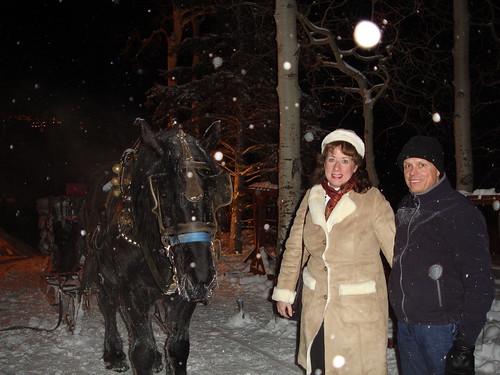
A very merry, snowy (if you like snow) and happy Christmas to all of our readers!
May Santa bring you whatever you're wishing for this year!
(Big Ben, Paula & John - Deer Valley, UT 2008)
Monday, December 22, 2008
Will We Have a Global Currency?
Reuters reported today that Japan, Germany and Canada, and Japan pledged new measures to confront the financial crisis.
The Belgian government officially collapsed over the weekend.
-Paula
The Belgian government officially collapsed over the weekend.
In neighboring Belgium, King Albert consulted political leaders after the government collapsed following its botched attempt to bail out financial group Fortis.This worldwide nature of the crisis, and the multinational efforts to meet it, call for extraordinary measures. Could one of those measures be to create a global currency? Some advantages:
Prime Minister Yves Leterme tendered his government's resignation on Friday after a report by the Supreme Court found signs of political meddling to sway a court ruling on the future of the bank, a victim of the credit crunch.
- It simplifies commerce between countries
- It provides stability to volatile currencies
- It lessens the fluctuations for global organizations, that may buy materials in one country, have manufacturing in another, and sell in another.
- Companies that make money from the cost differential. There will still be a cost differential, just as San Francisco is more expensive than Topeka Kansas, although they use the same currency.
- Individuals that make money betting on the foreign exchange.
-Paula
Monday, December 8, 2008
Press Coverage for the American Businesswoman's Politically Incorrect Guide to Bangalore

Just a quick note - the Tooele Transcript Bulletin published an interview about The American Businesswoman's Politically Incorrect Guide to Bangalore.
Color photo and everything!
Very nicely done, and thanks to Doug Radunich for being such a great interviewer/conversationalist/listener. I really enjoyed the discussion!
For more about the book, see http://www.bangaloreforbusinesswomen.com
Wednesday, December 3, 2008
Status of Professional Businesswomen in India
In the past, the Indian traditions followed from ages never allowed a ‘Woman’ to rule the business world like her male counterpart could. In this country, women play a prominent role in the well-being of her family. It may be due to this reason, Indian Women were discouraged from holding high managerial roles of the corporate world over the last decades.
 The courage and determination exhibited by many enterprising women of the country to revolt the traditional rules has helped ‘Indian Women’ find a more respectable status in the society and encouraged the new generation to follow. Currently, India is undergoing the feminist phase that U.S. went through during the early ‘70s. The advent of globalization encourages educated middle class women to take up opportunities to build her own dreams and excel in professions which were earlier perceived as complete male domain.
Although it’s quite ironic that ours is a nation where maternal mortality rates are among the worst in the world, yet the country can boast of the world’s largest number of professionally qualified women when compared with developed countries.
I would personally state the impact of the increased role of the private sector, the IT boom and the increase in the number of MNCs that have sprung up all over the country are among the notable reasons behind the success of the professional businesswoman of the country-in both professional and public sphere.
I would personally state the impact of the increased role of the private sector, the IT boom and the increase in the number of MNCs that have sprung up all over the country are among the notable reasons behind the success of the professional businesswoman of the country-in both professional and public sphere.
Monday, December 1, 2008
Have you changed your business travel plans or habits because of terrorism?
A very dear friend of ours lives in Mumbai.
In fact, she persuaded me to drink coconut water (an excellent cure for "traveler's tummy") in the Sea Lounge in the Taj Mahal hotel, across from the Gateway to India monument on the Mumbai waterfront last March.
She works at the Times of India and was in the neighborhood of the recent attacks in Mumbai. In fact, the Times of India building was fired upon. We had not heard from her for several days and did not know what to think, but I'm relieved to report she's unhurt. She just didn't have access to email for a few days. She watched the Taj and the Oberoi go up in flames.
My husband and I were discussing the events in Mumbai over the weekend, while sitting in a restaurant in Salt Lake City. Ironically, while we were sitting there, we saw lights through the window and heard sirens outside. There had been a very bad car crash outside the restaurant.
This put these events in perspective for us. We are concerned for the safety and happiness of our friends and family, wherever they are, and we take what precautions we think are prudent when we travel, but the fact remains that the statistical likelihood of being harmed in a terrorist attack is so low it is almost negligible compared to everyday risks like driving a car or crossing the street in our own neighborhood.
Would I return to Mumbai tomorrow? Absolutely. Would I stay in the Taj or the Oberoi? Absolutely, if they're open. They are beautiful, historic, wonderful hotels and will be so again.
I posted the question on my Linked In profile, and wanted to share some of the responses with you:
Have you changed your business travel plans or habits because of terrorism?
Here are the responses I received.
_________________________________
Subhas C Biswas
Trainer, Consultant and Auditor (9001, 14001, 16949 & 18001). subhascb@gmail.com
______________________________
Martin Kubler FIH
International Hotelier
__________________________
Oussama Salah
Head of Quality Assurance and Safety at AJA
________________________
Raja
International Strategic Business Consultant, Life Science, Animal Health, Pest Control, raja@biznezconsultant.com
______________________________
Viraj
Viraj Kalra
Vice President Animation and Media at Planman Technologies
PS - I read the content you sent across earlier and I think it is a great read and as informative as it gets.
_______________________
Edward Branley
Storage Area Networking Expert (HDS & EMC), Published Author, New Orleans Historian, Streetcar Historian/Afficianado
________________
Josh.
Josh Chernin
General Manager, Itinerant Writer, and Decent Little League Coach
______________
Author, Educator, CEO at GameChangers
___________________________
President at Paris New Media, LLC & BonjourParis.com
____________________________
Travel Specialist (LION) at Rubinsohn Travel
_____________________________
Pooja Gupta
Project coordinator at Brickwork
________________________
Michaela Broeckx
International & Intercultural Business Trainer
Links:
http://www.fareedzakaria.com/
________________________________
What do you think? Reply below or write to paula@ravenwerks.com
In fact, she persuaded me to drink coconut water (an excellent cure for "traveler's tummy") in the Sea Lounge in the Taj Mahal hotel, across from the Gateway to India monument on the Mumbai waterfront last March.
She works at the Times of India and was in the neighborhood of the recent attacks in Mumbai. In fact, the Times of India building was fired upon. We had not heard from her for several days and did not know what to think, but I'm relieved to report she's unhurt. She just didn't have access to email for a few days. She watched the Taj and the Oberoi go up in flames.
My husband and I were discussing the events in Mumbai over the weekend, while sitting in a restaurant in Salt Lake City. Ironically, while we were sitting there, we saw lights through the window and heard sirens outside. There had been a very bad car crash outside the restaurant.
This put these events in perspective for us. We are concerned for the safety and happiness of our friends and family, wherever they are, and we take what precautions we think are prudent when we travel, but the fact remains that the statistical likelihood of being harmed in a terrorist attack is so low it is almost negligible compared to everyday risks like driving a car or crossing the street in our own neighborhood.
Would I return to Mumbai tomorrow? Absolutely. Would I stay in the Taj or the Oberoi? Absolutely, if they're open. They are beautiful, historic, wonderful hotels and will be so again.
I posted the question on my Linked In profile, and wanted to share some of the responses with you:
Have you changed your business travel plans or habits because of terrorism?
Here are the responses I received.
_________________________________
No. But, I am keeping extra time for obvious checks and delays at check-points during travel.
I am avoiding meeting people in soft targets, and keeping the entry and exit routes in perspective while entering a crowded place.
Subhas C Biswas
Trainer, Consultant and Auditor (9001, 14001, 16949 & 18001). subhascb@gmail.com
______________________________
I will probably be staying at less high profile hotels for future trips to locations that may be targeted.
Other than that and the points mentioned by Subhas, I will not make any changes.
Martin Kubler FIH
International Hotelier
__________________________
I have made allowances for longer delays at airports for security checks and certainly I pay more attention to the news of what is going on at my destination. On the whole NO.
Oussama Salah
Head of Quality Assurance and Safety at AJA
________________________
I continue to travel as I have always done even after 911. If an incident of terrorism had occured somewhere today I will not be rushing over there but if I had to go there in a week or two I have no problem in visiting that city on business. Terrorism has become a worldwide threat and we should not let that get on top of us. We need to stay on top!
Cheers
Raja
International Strategic Business Consultant, Life Science, Animal Health, Pest Control, raja@biznezconsultant.com
______________________________
Dear Paula,
I was at the SF airport while all hell broke loose in Mumbai. And honestly it was very frustrating considering that I had at least 4 meetings while I was in US where the decision-makers were to visit us in India between Dec and Feb and my first reaction was that they will now not come. But I spoke with them on Friday and they all plan to stick by the initial itinerary irrespective!
So, I think that today a business traveler’s mentality is so attuned to terrorism that such incidents rarely have effect on their direct and physical dealing with any region globally. I mean you could be in Paris, New York or Joberg and still be under as much threat.
Of course unless you are talking about war zones where chances are that on any given day you would get caught in crossfire, that being said I think while visiting India fighting pollution, water-born diseases and traffic is a bigger challenge than terrorism!
On the whole I am kind of happy that the security checks at both airports and hotels will get ramped-up, it will make me feel more secure. I will make more time for all of that.
But other than that me or anyone I know personally is no way changing travel plans because of the utterly sick yet freak incident in Mumbai.
Thanks,
Viraj
Viraj Kalra
Vice President Animation and Media at Planman Technologies
PS - I read the content you sent across earlier and I think it is a great read and as informative as it gets.
_______________________
Given the overall freak-out of 9/11 and the London-based cell that sparked the liquids bans/restrictions, Mumbai's attacks won't have that much of an impact on domestic US or US to EU business travel. For all of the horror of Mumbai, the US DHS "alert" is so high as it is that the attacks didn't even register a blip. (No doubt the fact that the US has so little influence on Indian domestic policies plays the most significant role here.)
That said, I would encourage President Obama's DHS people to drop the daily security "alert" from Orange back to Green. We've had seven years of "high-alert" conditions now, it's the norm. Put some respect back into the system, and then TSA could raise green to yellow for things like Mumbai.
Edward Branley
Storage Area Networking Expert (HDS & EMC), Published Author, New Orleans Historian, Streetcar Historian/Afficianado
________________
Hi Paula,
I have changed any plans. I think it would be a shame if anyone did, albeit appropriate precautions should be taken by all including the authorities. We just can't let terrorists run our world.
Josh.
Josh Chernin
General Manager, Itinerant Writer, and Decent Little League Coach
______________
No. I plan to work at home just the way I was before Mumbai.Mike Bonifer
Serously, I told my friend Kevin Wall that I'd head to Mumbai this week, to help hold together the Live Earth-India concert that was scheduled for Mumbai on Dec. 7, but Al Gore, Wall, and Rejendra Pachauri canceled the event. It is easy for me to say since my name isn't on the line for it, but I do feel that it was the wrong move, and that Gore was a fraidy cat for pushing the other two partners to cancel.
First of all, there's so much vigilance, Mumbai is going to be one of the safer mega-cities for a while. Terrorists hit where people aren't looking, not where they ARE. So it is kind of naive to back out bc of a 'heightened threat level.'
Second, they could've scaled back the concert into something very small, somber and symbolic, all Indian artists, and it would have been an even more important event than any kind of 'Bon Jovi Against Global Warming' concert would have been...but they backed out. It was a gigantic opportunity and they missed it. Sad but true. This has a down-impact for sure on travel and smothers what could have been the first positive news from Mumbai since the attacks.
Links:
Author, Educator, CEO at GameChangers
___________________________
Karen Fawcett
Unfortunately, I've been forced to cancel today's arrival in Bangkok and travel via Singapore. On the return portion of the trip, I hope to be able to stop in Bangkok. I will be careful. But I refuse to allow terrorists to keep me from traveling. I could more likely be killed jay-walking in Paris or in NYC.
Links:
http://www.bonjourparis.com
http://www.tripso.com
President at Paris New Media, LLC & BonjourParis.com
____________________________
Paula,Adrienne Sasson
Can you predict where the next terrorism attack will take place? I can't, so how should I change my plans for business or pleasure?
If people begin to run scared of a perceived attack, then they win! My ego will not permit it. Which city will you give up:
NY
Paris
LA
Madrid
London
Dublin
Jerusalem
Cairo
Mumbai
Amman
Argentina
What have I forgotten?
Travel Specialist (LION) at Rubinsohn Travel
_____________________________
Nope, I have not changed any travel plans. But surely staying away from gatherings or any other crowded places
Pooja Gupta
Project coordinator at Brickwork
________________________
Hallo Paula,
Thank you for this question - which is interesting because the welfare of our global economy, even in these uncertain times, depends for a great deal on the continued exchange of capital, goods and services worldwide.
As far as I am concerned, I guess I wouldn't cancel a businesstrip to Mumbai if the business requires my traveling there. It seems to me that there is no more actual danger, either in Mumbai or anywhere in the world, than one would come across in Belgium when negotiating the ring road around Brussels, or any road of the sorts, during rush hour.
As a matter of fact, terrorist threats pose a problem all over the world, and no less in Europe than anywhere else. I guess we will just have to learn how to cope with a lasting feeling of unsafety and uncertainty created by our current political turmoil.
I realize that this attitude of mine might well be influenced by the mere fact of my belonging to an at first sight insignificant national citizenship (Belgium). I am not quite sure that I would be as much at ease if I would be holding an American passport.
However: Even for Americans, the news might not be all that bad, for, as Fareed Zakaria has mentioned in his much acclaimed The Post American World (2008), "It seems that we are living in crazily violent times, but don't believe everything you see on television. Our anecdotal impression turns out to be wrong. War and organized violence have declined dramatically over the last two decades."
So, it appears that, maybe, our world and our global exchange situation isn't in such bad health after all.
Kind regards,
Michaela Broeckx
International & Intercultural Business Trainer
Links:
http://www.fareedzakaria.com/
________________________________
What do you think? Reply below or write to paula@ravenwerks.com
Monday, November 24, 2008
Do’s and Don’ts for American Businesswomen in India
We get used to the culture of the country that we are brought up in. So long as we don’t have to deal with people from different countries we never give a thought to the concept ‘Cultural Differences’. It is always beneficial to understand the culture of the country where you intend to do business.
‘Indian culture’ can take an American by surprise at all stands. For instance, the perception of ‘Time’ to an Indian differs considerably from what it means to a westerner.
 There is no denying the fact that women in
While using the first name is not common in business circle, seniors and superiors are addressed formally and with respect. Although Indians are known for hospitality; one should not expect to be entertained at home at the very first instance. Among the other significant business etiquette, giving or receiving using the ‘Left-hand’ will be considered offensive by an Indian.
I am sure that reading this small article would have taken you by surprise. You will certainly agree with me that a little preparation before your Indian business trip, or for that matter, to any foreign country, will save you the expected ‘Culture Shock’!
Thursday, November 20, 2008
Is Now a Good Time to Consider a Venture in the US?
I wrote this as an introduction for 16 Vital Questions, A Primer for Indians Traveling in the U.S. ICFAI Books will be publishing this book soon as a guide for students and interns from India planning a sojourn into the U.S. for work or school.
But I thought it would be particularly relevant to the group here as well since we talk about multicultural issues and the interdependence of our economies!
Introduction –Is Now a Good Time to Consider a Venture in the US?
Mr. Muralidaran, the General Manager at ICFAI Books, wrote me a question last night that gave me pause.
In view of the recent happenings in the US (financial crisis, recession in the economy, job cuts, and the presidential elections) I was wondering whether you would like to make some modifications to your book.
My first thought was that I didn’t want to change or add anything.
The information in the book is as complete as we can make it, barring the usual volatility of situations. Everything is still true and correct. The opportunities in the U.S. are always changing, but there are always excellent opportunities here for bright, ambitious people.
But then I started thinking about all of the parents that will read this book as they consider educational and professional opportunities for their children. My son Michael (we call him Mickey) just moved into the dorms and started as a freshman at the University of Nevada Las Vegas, which is about six hours by car from where we live. As a parent, this still seems like it’s a very long way away. If the best opportunity for his particular desires and ambitions had been literally halfway around the world, I would have had some trepidation. I would want to know everything I could find out about the place he would be spending time. These decisions bear careful consideration and what we’ve been reading and hearing in the news is enough to make anyone second-guess a good decision.
I decided that 16 Vital Questions can’t be published without some mention of the unprecedented activity of the last three to six months.
Economics and politics work in cycles, like the weather. We know that every year there will be winters and summers, as well as some unpredictable “storms.”
Economics – The cycles of the stock market are well known. Recent banking failures give us all pause. These organizations made bad financial decisions and, although there is disagreement among Americans about whether government (taxpayer) money should be used to sustain and repair them; the decision for better or worse has been made and we will find out how things progress.
The long-term implications are unknown, but history tells us that the United States has a very resilient economy. This may be the “winter” part of the economic cycle. There is lots of discussion about how long or cold the “winter” may be where the next storms might happen, but no one doubts that there will be a recovery. The very size, diversity and complexity of the U.S. economy create new opportunities out of every failure. If stockholders who held shares during the Great Depression of the 1920s (the worst financial crisis in our history) had simply held on to their stocks for one or two years, their holdings would have come back to their previous value.
The Financial Times of London reports today (11/18/2008)
This is actually excellent news for anyone planning an education or venture in the US. Prices for housing, fuel and food are lower than usual at the moment; and as the economy improves, (as it certainly will in the next one to three years) there will be more opportunities in that follow.
It’s not a bad time to begin a career in the US, if one can find a solid opportunity in a growth industry in some parts of the US. Unemployment is higher than usual at the moment, and it may be prudent to look very carefully at the finance and heavy manufacturing industries until we know more about how events will play out in the next few months. But there are industries that are doing very well.
Two examples of heavy manufacturing depend a great deal on a variation of product and region - The automotive industry in Detroit Michigan is laying people off, but the Cessna small airplane factory in Independence Kansas has not even slowed down.
Good opportunities can be found if you research variations within an industry and look in different parts of the country.
Politics – Barack Obama’s election has created excitement among young people all over the world.
Last night, (11/17/2008) my blogging buddy Rajani Paniker from Bangalore posted this on the Ravenwerks Blog:
Events here in the US impact India much more than they did several years ago, and events in India are watched from the United States with much greater interest as we find our companies, economies, friendships and families more interconnected than ever before.
Conclusion -
I look forward to an era of continued cooperation, collaboration and prosperity between the U.S. and India. In four years, when my son Mickey graduates from college, I expect that we will be back to the “summer” part of the cycle yet again. If you, or your loved ones are able to make a trip, I hope that the cycles of economics and politics work in your favor. I am sure that traveling and commerce brings us better understanding, prosperity and friendship.
Warm regards and best wishes in your endeavors and travels,
-Paula Williams
www.ravenwerks.com
Transcending Boundaries
But I thought it would be particularly relevant to the group here as well since we talk about multicultural issues and the interdependence of our economies!
Introduction –Is Now a Good Time to Consider a Venture in the US?
Mr. Muralidaran, the General Manager at ICFAI Books, wrote me a question last night that gave me pause.
In view of the recent happenings in the US (financial crisis, recession in the economy, job cuts, and the presidential elections) I was wondering whether you would like to make some modifications to your book.
My first thought was that I didn’t want to change or add anything.
The information in the book is as complete as we can make it, barring the usual volatility of situations. Everything is still true and correct. The opportunities in the U.S. are always changing, but there are always excellent opportunities here for bright, ambitious people.
But then I started thinking about all of the parents that will read this book as they consider educational and professional opportunities for their children. My son Michael (we call him Mickey) just moved into the dorms and started as a freshman at the University of Nevada Las Vegas, which is about six hours by car from where we live. As a parent, this still seems like it’s a very long way away. If the best opportunity for his particular desires and ambitions had been literally halfway around the world, I would have had some trepidation. I would want to know everything I could find out about the place he would be spending time. These decisions bear careful consideration and what we’ve been reading and hearing in the news is enough to make anyone second-guess a good decision.
I decided that 16 Vital Questions can’t be published without some mention of the unprecedented activity of the last three to six months.
Economics and politics work in cycles, like the weather. We know that every year there will be winters and summers, as well as some unpredictable “storms.”
Economics – The cycles of the stock market are well known. Recent banking failures give us all pause. These organizations made bad financial decisions and, although there is disagreement among Americans about whether government (taxpayer) money should be used to sustain and repair them; the decision for better or worse has been made and we will find out how things progress.
The long-term implications are unknown, but history tells us that the United States has a very resilient economy. This may be the “winter” part of the economic cycle. There is lots of discussion about how long or cold the “winter” may be where the next storms might happen, but no one doubts that there will be a recovery. The very size, diversity and complexity of the U.S. economy create new opportunities out of every failure. If stockholders who held shares during the Great Depression of the 1920s (the worst financial crisis in our history) had simply held on to their stocks for one or two years, their holdings would have come back to their previous value.
The Financial Times of London reports today (11/18/2008)
Economists believe that the US has been in recession since April and will remain there until the middle of 2009, according to a survey by the Federal Reserve Bank of Philadelphia.
This is actually excellent news for anyone planning an education or venture in the US. Prices for housing, fuel and food are lower than usual at the moment; and as the economy improves, (as it certainly will in the next one to three years) there will be more opportunities in that follow.
It’s not a bad time to begin a career in the US, if one can find a solid opportunity in a growth industry in some parts of the US. Unemployment is higher than usual at the moment, and it may be prudent to look very carefully at the finance and heavy manufacturing industries until we know more about how events will play out in the next few months. But there are industries that are doing very well.
Two examples of heavy manufacturing depend a great deal on a variation of product and region - The automotive industry in Detroit Michigan is laying people off, but the Cessna small airplane factory in Independence Kansas has not even slowed down.
Good opportunities can be found if you research variations within an industry and look in different parts of the country.
Politics – Barack Obama’s election has created excitement among young people all over the world.
Last night, (11/17/2008) my blogging buddy Rajani Paniker from Bangalore posted this on the Ravenwerks Blog:
The Chancery Pavilion at Bangalore witnessed Obama’s supporters eagerly waiting for the latest U.S. Presidential election updates. When the final results were telecast on the television, a loud cheer was heard and people were found hugging and congratulating each other. . . .
Events here in the US impact India much more than they did several years ago, and events in India are watched from the United States with much greater interest as we find our companies, economies, friendships and families more interconnected than ever before.
Conclusion -
I look forward to an era of continued cooperation, collaboration and prosperity between the U.S. and India. In four years, when my son Mickey graduates from college, I expect that we will be back to the “summer” part of the cycle yet again. If you, or your loved ones are able to make a trip, I hope that the cycles of economics and politics work in your favor. I am sure that traveling and commerce brings us better understanding, prosperity and friendship.
Warm regards and best wishes in your endeavors and travels,
-Paula Williams
www.ravenwerks.com
Transcending Boundaries
Monday, November 17, 2008
Election of Barack Obama and Bangalore
Barack Obama led the Democrats to a sweeping victory in the U.S. President elections recently.  His victory was rejoiced in all parts of the world. As the world celebrated this historic victory,
The Chancery Pavillion at
Subscribe to:
Posts (Atom)



